

Home Care Scalability Design: Building a Hybrid Workforce Architecture
Jingoo Operational Intelligence Series
Authored by the Jingoo Systems Architecture Team
Executive Summary
Home care scalability design determines whether growth strengthens stability or amplifies instability. As census expands, complexity increases across intake, scheduling, billing, compliance, and reporting.
Within the Jingoo Operational Intelligence Framework™, scalable operations require hybrid workforce architecture—integrating human oversight, structured workflows, automation layers, and AI support. Growth must be architected.
The Growth Plateau
An agency grows from 40 clients to 85. Revenue increases. Staffing expands. Referral activity accelerates.
Then complexity surfaces.
Leadership spends more time intervening. Coordinators feel pressure. Billing cycles fluctuate. Reporting becomes fragmented. Growth without design amplifies instability.
Why Scaling Operations Is Different From Growing Census
Operational scalability in home care is not measured by volume alone. It is measured by how well systems absorb complexity. When processes depend on individual memory or manual coordination, growth increases fragility.
Scalability demands architecture.
The Hybrid Workforce Architecture
Within the Jingoo Operational Intelligence Framework™, scalability rests on a layered model:
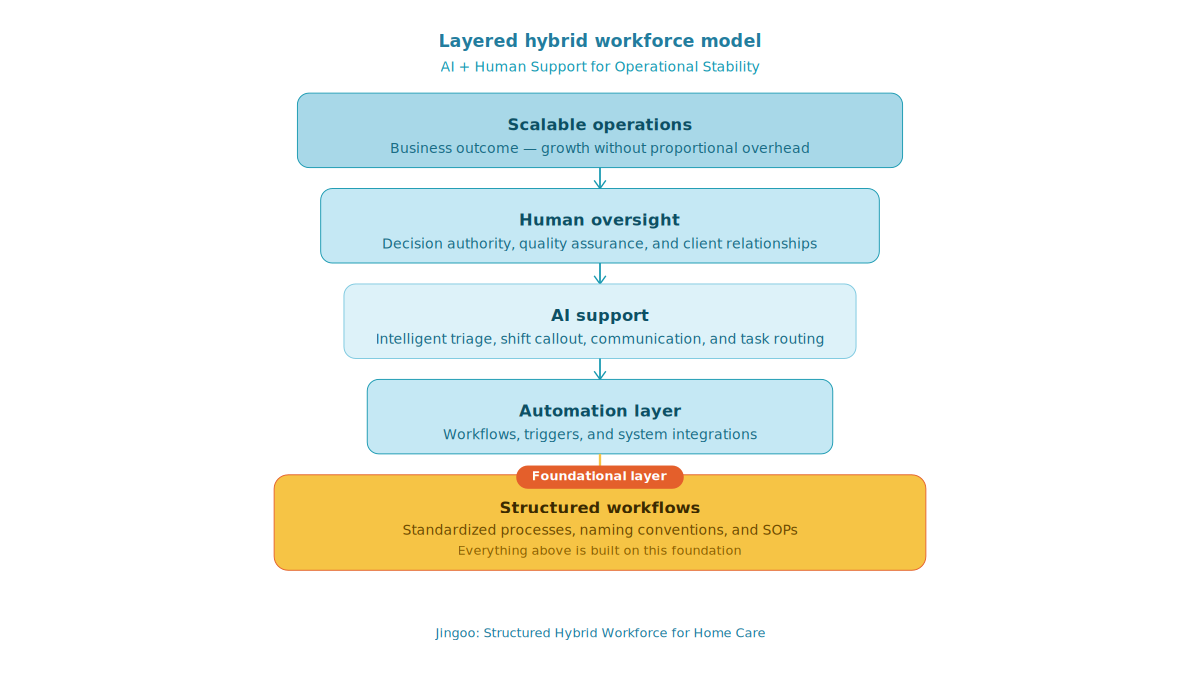
Structured workflows become the foundation. Without them, automation amplifies confusion.
The Role of Human Oversight
Human leadership defines standards, escalation logic, and accountability. Oversight ensures judgment, empathy, and contextual decision-making remain central. Hybrid does not replace humans. It supports them.
The Automation Layer
Workflow automation strategy stabilizes repetitive processes:
- Authorization tracking
- Intake routing
- Scheduling notifications
- Documentation reminders
- Billing cadence alerts
Automation increases consistency when structure is defined.
The Role of AI Support
AI systems assist with data triage, communication routing, and performance monitoring. When aligned with structured workflows, AI increases speed without sacrificing oversight. When deployed without architecture, AI increases noise.
Reframing Scalability Through the Framework
Scalability engages all five pillars:
- Visibility — Are metrics unified across layers?
- Ownership — Are escalation paths defined?
- Timing — Are processes predictable under load?
- Structure — Are workflows documented and layered?
- Leverage — Is automation reinforcing clarity?
Scalable organizations design before they expand.
The Executive Advantage of Hybrid Architecture
- Reduces intervention frequency
- Improves reporting clarity
- Stabilizes revenue timing
- Strengthens compliance oversight
- Growth becomes controlled rather than reactive
Executive Reflection
If census increased 30% tomorrow, would stability strengthen—or fracture?
Are workflows documented—or institutionalized through memory?
Does automation reinforce clarity—or compensate for inconsistency?
Scalability is architectural.
Final Thought
Home care scalability design is not a staffing initiative. It is a systems discipline. Hybrid workforce architecture integrates human oversight, structured workflows, automation, and AI support into unified operational resilience. Growth becomes sustainable when design precedes expansion.
Leave a Reply